Dorset Geologists’ Association Group (DGAG) will host a talk on Tuesday 08 December 2026.
Title: Somerset Geology and Ham Hill (Provisional, to be confirmed)
Speaker: Geoff Rowland
Time: Talk will start at 7pm; finish approximately 8pm
Venue: Activity Meeting Room: Dorford Centre, Bridport Road, Dorchester, DT1 1RR
Lecture Entry Cost: All welcome: £6 non-members (£5 DGAG members), cash please.
Booking a seat: contact Chris Webb at email: events@dorsetgeologistsassociation.org
Talk Description: To be confirmed
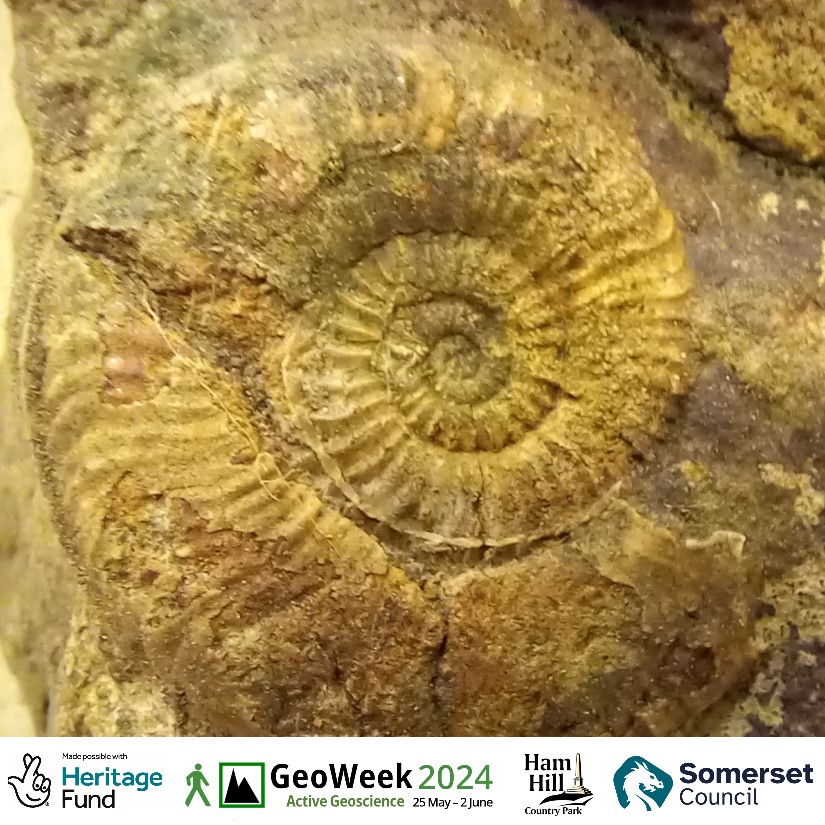
Photo: Provisional pending a better one from speaker
Additional Links: To be confirmed
Dorset Geologists’ Association Group (DGAG) will host a talk on Tuesday 20 October 2026.
Title: Listening to the past: The extraordinary evolution of the mammalian middle ear
Speaker: Dr James Rawson finished his PhD in Bristol last year and has just started a new job as a Postdoctoral Research Fellow at King’s College London.
Time: Talk will start at 7pm; finish approximately 8pm
Venue: Activity Meeting Room: Dorford Centre, Bridport Road, Dorchester, DT1 1RR
Lecture Entry Cost: All welcome: £6 non-members (£5 DGAG members), cash please.
Booking a seat: contact Chris Webb at email: events@dorsetgeologistsassociation.org
Talk Description: A synopsis kindly provided by the speaker is as follows:
Mammals are among the most widespread and ecologically significant animals on Earth, spanning a huge range of sizes, habitats and ecologies. Modern mammals, from bats to whales to humans, share several anatomical features but the most diagnostic is a unique middle ear containing three bones (hammer, anvil, stirrup). Remarkably, two of these bones once performed a very different function; in all other vertebrates they form the joint between the lower jaw and the skull! The evolution of these elements from load-bearing jaw joint to delicate ear bones has long been upheld as a textbook example of function driving morphological adaptation, with renowned naturalist Sir Richard Owen first describing fossil evidence for this transition in 1845. Questions surrounding this unique evolutionary story have persisted since Owen’s day, including how, and most importantly why, mammals evolved one of their most unique features. This talk will follow the story of the mammalian middle ear from its origin in mammals’ Permian ancestors to the modern day and show how remarkable fossil discoveries from across the world have reshaped our understanding of mammal evolution over these last two mammal evolution over these last two decades. This talk will also cover some of the innovative methods palaeontologists are using to tackle big questions in mammal evolution, borrowing methods from developmental biology, engineering and biomedical science.
“DGAG editors view —-> This talk is not to be missed as it gives an entertaining start to our 2026 Autumn talk season
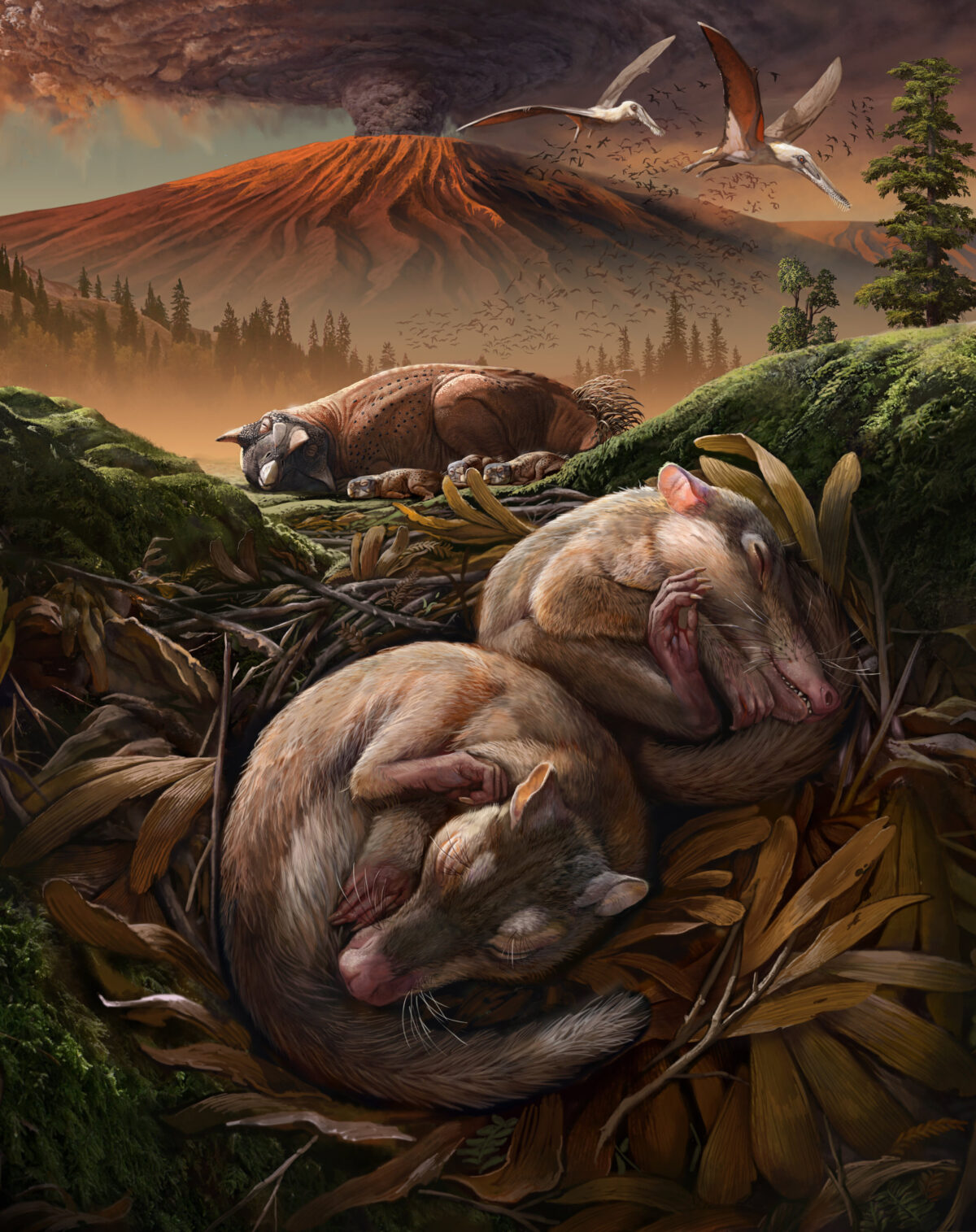
Photo: Early mammals- Courtesy of the speaker: Credit for the image should be given to Zhao Chuang, and it was created for this study: Integrated hearing and chewing modules decoupled in a Cretaceous stem therian mammal Science. 5 Dec 2019. Vol 367, Issue 6475. pp. 305-308
Additional Links:
1. Link to paper that image was created for: https://www.science.org/doi/10.1126/science.aay9220
Dorset Geologists’ Association Group (DGAG) will host a talk on Tuesday 17 November 2026.
Title: The Whispers of Rock – Stories from the Earth
Speaker: Dr Anjana Khatwa is an award-winning earth scientist, presenter and writer who has worked for several universities, the Jurassic Coast World Heritage Site and the National Trust. She has been given the Geographical Award for public engagement by the Royal Geographical Society, the RH Worth Award by the Geological Society of London and the Halstead Medal from the Geologists’ Association. Anjana lives with her family in Dorset in a house filled with rocks and fossils collected from all over the world. The Whispers of Rock is her first book.
Time: Talk will start at 7pm; finish approximately 8pm
Venue: Activity Meeting Room: Dorford Centre, Bridport Road, Dorchester, DT1 1RR
Lecture Entry Cost: All welcome: £6 non-members (£5 DGAG members), cash please.
Booking a seat: contact Chris Webb at email: events@dorsetgeologistsassociation.org
Talk Description: A synopsis kindly provided by the speaker is as follows:
If you listen, can you hear the rocks speak? The question seems absurd. After all, rocks are lifeless, inert, and silent in The Whispers of Rock: Stories from the Earth, earth scientist Anjana Khatwa will ask us to think again and listen to their stories. Boldly alternating between modern science and ancient wisdom, Khatwa will take you on an exhilarating journey through deep time, from origins of the green pounamu that courses down New Zealand rivers to the wonder of the bluestone megaliths of Stonehenge, from the fiery volcanoes of Hawai’i to Manhattan’s bedrock of schist. In unearthing those stories and more, Khatwa will show how rocks have always spoken to us and we humans to them. Delicately intertwining Indigenous stories of Earth’s creation with our scientific understanding of its development, she will showcase how our lives are intimately connected to time’s ancient storytellers.
“DGAG editors view —-> This talk is not to be missed and will be a privilege to join the author in a fantastic dive into the universe of rocks merging science, art and human existence”.
In addition, as a real treat, Teasel and Skylark (independent bookseller in Dorchester) will be at the meeting selling books and there will be a book signing on the night.
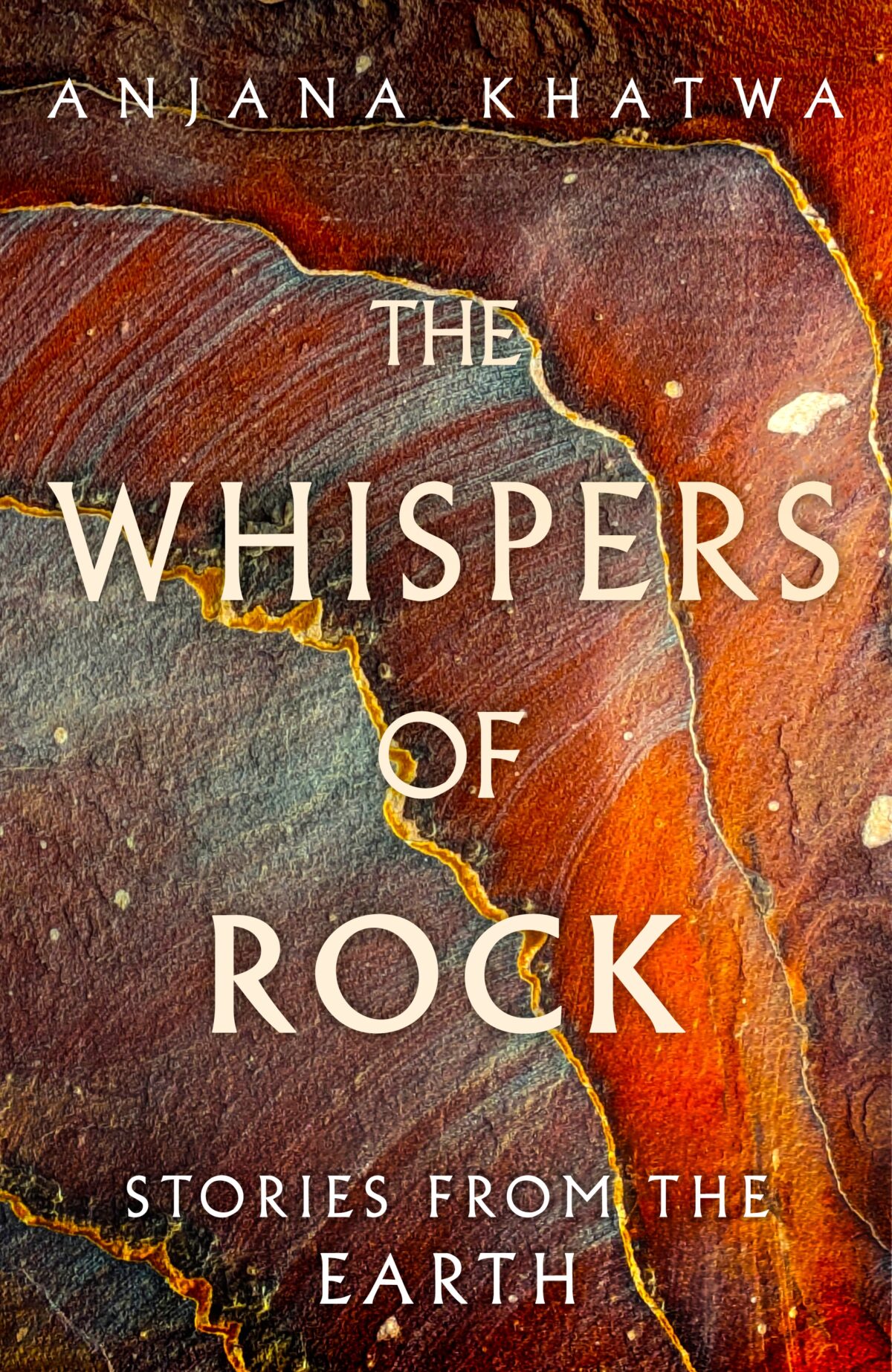
Photo: -Courtesy of the speaker’s representative and a paperback version hopefully later when available . Cover of the UK hard back published in 2025
Additional Links:
if and when available later

Dorset Geologist’s Association Group (DGAG) will host a talk on the Tuesday 17th February 2026.
Title: Geoscience in a Digital Age: The Role of the Internet in Modern Geoscience
Speaker: Saskia Elliott (MSc, FGS, Graduate Geotechnical Engineer at SW Flood and Coastal)
Time: Talk will start at 7pm; finish approximately 8pm
Venue: Activity Meeting Room: Dorford Centre, Bridport Road, Dorchester, DT1 1RR
Lecture Entry Cost: All welcome: £6 non-members (£5 for DGAG members), cash best.
Booking a seat: contact Chris Webb at email: events@dorsetgeologistsassociation.org
Talk Description: To be provided by the speaker in due course.
Editors view –>Hopefully, this taster, will give us a few clues to using some of the universe of information resources, that we are privileged, to have at our fingertips, in this digital, online AI era! The additional links below are a good start.
Photo: Algal fossil surprise on the Dorset Coast from the speaker
Additional Links:
- British Geological Survey on the topic
https://www.bgs.ac.uk/geological-research/digital-geoscience/2.The Geological Society comments on topic
https://www.geolsoc.org.uk/events/digital-geoscience-2025-digital-innovations-in-geoscience-fieldwork/3. The French geological survey on same topic
https://www.brgm.fr/en/activities/knowledge-dissemination-open-science
Dorset Geologist’s Association Group (DGAG) will host a talk on the Tuesday 21st April 2026.
Title: Continental collision in the Alps
Speaker: Giles Droop (DGAG member and former University lecturer)
Time: Talk will start at 7pm; finish approximately 8pm
Venue: Activity Meeting Room: Dorford Centre, Bridport Road, Dorchester, DT1 1RR
Lecture Entry Cost: All welcome: £6 non-members (£5 DGAG members), cash please.
Booking a seat: contact Chris Webb at email: events@dorsetgeologistsassociation.org
Talk Description: The European Alps are arguably the most thoroughly studied mountain belt on Earth and have become the ‘gold standard’ of belts formed by continental collision. However, in some ways the Alps are not typical because they are the product of an extended ‘train crash’ of micro-continents and small intervening ocean basins. In this talk I shall present evidence for the various continental and oceanic materials of various ages caught up in the collision zone and show how they have been tortured by plastic deformation and metamorphism, producing spectacular new structures, textures and minerals. I shall summarise how information from metamorphic mineral assemblages can be used to deduce the temperatures and pressures to which the various rock units were subjected, and how deep those units were subducted before being returned to the Earth’s surface by erosion and buoyancy forces.
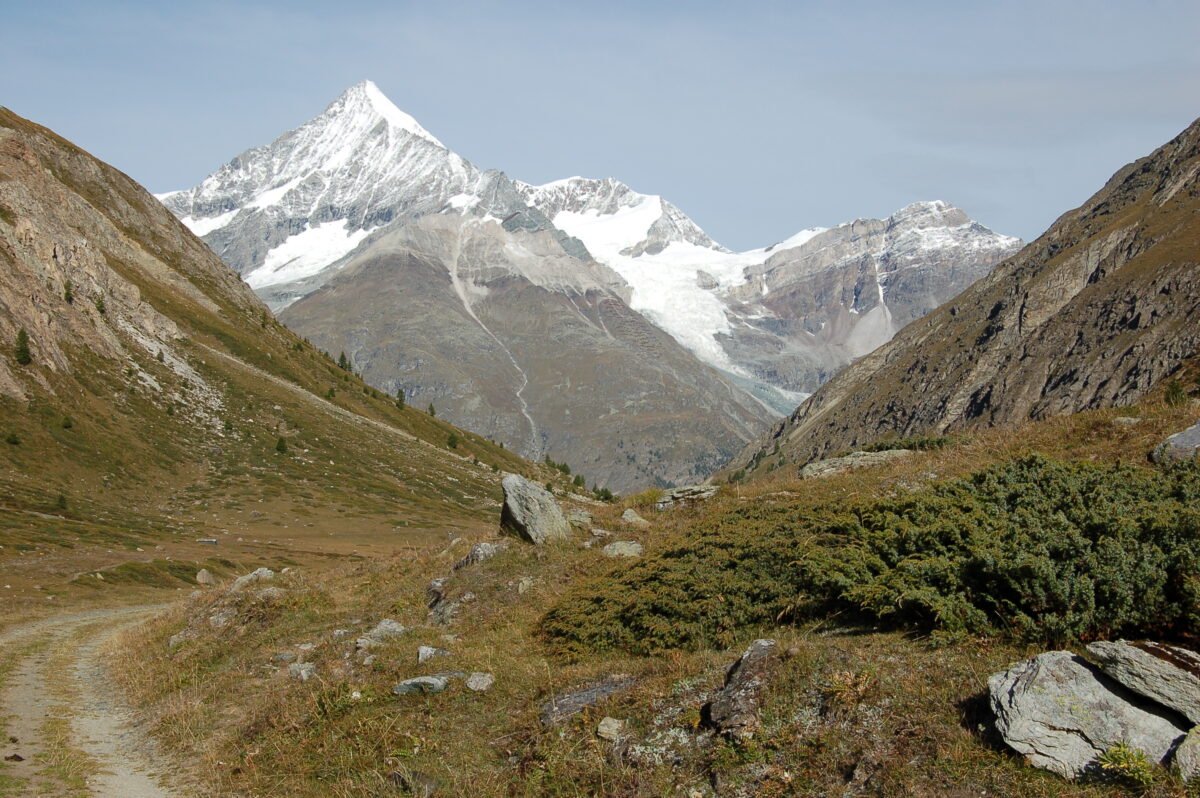
Photo: European Alps-Tasch Weisshorn (Courtesy of speaker)